Podcast: Play in new window | Download
![(L-R) Mike Belkin, Curt Reilly, President GLVFA [Photo by Sarah Nachin]](https://vietnamveterannews.com/wp-content/uploads/2025/12/3170.png)
(L-R) Mike Belkin, Curt Reilly, President GLVFA [Photo by Sarah Nachin]
Podcast: Play in new window | Download
![(L-R) Mike Belkin, Curt Reilly, President GLVFA [Photo by Sarah Nachin]](https://vietnamveterannews.com/wp-content/uploads/2025/12/3170.png)
(L-R) Mike Belkin, Curt Reilly, President GLVFA [Photo by Sarah Nachin]
Podcast: Play in new window | Download

Jim Fredrick, author of Opening Weekend.
Podcast: Play in new window | Download

Arnett in Vietnam in 1967. In 1966, he was inches away from an American colonel who was shot to death by a North Vietnamese sniper. Arnett won a Pulitzer Prize for his reporting from the war-torn country.
AP Corporate Archives/AP Photo
Podcast: Play in new window | Download

The Wall That Heals

The Wall That Heals
Podcast: Play in new window | Download

Dr. Harley Kelley today.
Podcast: Play in new window | Download

Bao Ninh
Podcast: Play in new window | Download
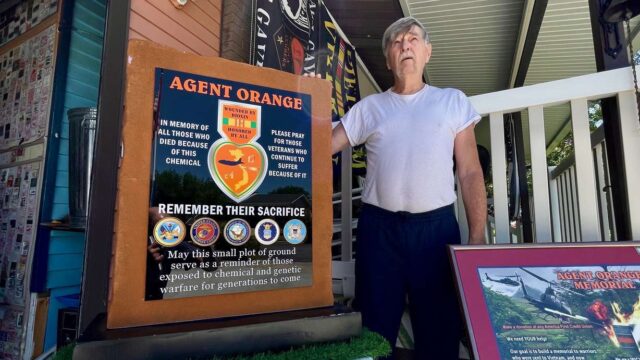
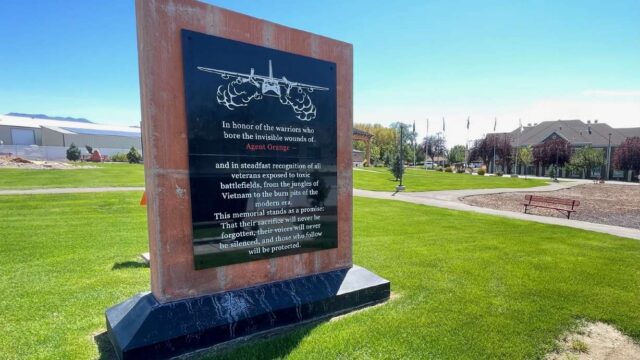
Episode 3164 of the Vietnam Veteran News Podcast will feature a story about MSD and how it effects Vietnam Veteran. The featured story is titled: Agent Orange Linked To Rare Bone Marrow Cancers. It appeared on the U.S. News website and was submitted by Dennis Thompson. He is a HealthDay Reporter.
Thompson reported that a major new study has found a clear link between exposure to the Vietnam War–era defoliant Agent Orange and a heightened risk of myelodysplastic syndrome (MDS), a rare and slowly developing bone marrow cancer. Presented at an American Society of Hematology meeting, the research shows that veterans exposed to Agent Orange not only face a greater likelihood of developing MDS, but also tend to be diagnosed at younger ages and with more aggressive forms of the disease.
Lead researcher Dr. Mikkael Sekeres of the University of Miami explained that the study fills a long-standing gap: although Agent Orange has previously been tied to blood cancers such as lymphoma, multiple myeloma, and leukemia, no definitive connection to MDS had been established due to a lack of comprehensive data. The new analysis drew from a federally funded registry that tracked patients with suspected or confirmed MDS between 2016 and 2024. Among 2,115 participants, 130 reported Agent Orange exposure.
Those exposed were more likely to carry harmful genetic mutations linked to high-risk MDS, reflecting patterns typically seen in cases caused by toxic exposures. Researchers noted that Agent Orange may accelerate the decades-long sequence of genetic changes that culminate in MDS, allowing the first mutation to occur earlier in life. While overall survival did not differ significantly, exposed patients had double the risk of disease progression after diagnosis.
The study also highlighted racial disparities: Black veterans were more than twice as likely as white veterans to encounter the toxin. Researchers hope the findings will aid veterans seeking coverage for MDS treatment and plan to validate the results using national veteran databases.
Listen to Episode 3164 and discover more about MSD and how it effects Vietnam Veteran.
Podcast: Play in new window | Download

United States Air Force B-52 bombing crews at Andersen Air Base in Guam being briefed on the U.S.’s final major aerial bombing campaign in North Vietnam, Operation Linebacker II. (Wikimedia Commons)
Episode 3163 of the Vietnam Veteran News Podcast will feature a story about Operation Linebacker II. The featured story is titled: Operation Linebacker II: The Bombing Campaign That Forced North Vietnam to the Peace Table in 1973. It appeared on the Military.com website and was submitted by Allen Frazier. He is a U.S. Army veteran and military journalist based in Wyoming who covers military history, current events, and world affairs for Military.com.
Frazier reported that In December 1972, peace talks between the United States and North Vietnam collapsed when Hanoi’s negotiators walked out of the Paris negotiations. In response, President Richard Nixon launched Operation Linebacker II, an intense eleven-day B-52 bombing campaign against Hanoi and Haiphong. Despite international condemnation and heavy civilian casualties, the offensive quickly pressured North Vietnam back to the negotiating table, leading to the Paris Peace Accords signed on January 27, 1973.
The accords ended direct American combat involvement and secured the return of U.S. prisoners of war, but allowed North Vietnamese troops to remain in South Vietnam—an issue that had derailed earlier negotiations. The settlement resembled the draft agreement reached in October 1972 that South Vietnamese President Nguyen Van Thieu had rejected. Though Nixon privately promised to defend South Vietnam if the North violated the pact, Watergate soon crippled his authority, and Congress later blocked renewed U.S. military action.
The bombing campaign capped years of air operations that had failed to break Hanoi’s resolve. Rolling Thunder (1965–68) inflicted massive damage but was constrained by political limits. Linebacker I (May–Oct. 1972) removed many restrictions and helped stall North Vietnam’s Easter Offensive, setting conditions for renewed negotiations. Yet none of these campaigns altered the fundamental political reality: North Vietnam remained determined to reunify the country under communist rule.
Both sides violated the Paris Peace Accords almost immediately, and full-scale war resumed. With U.S. support withdrawn and aid sharply reduced, South Vietnam collapsed under North Vietnam’s final 1975 offensive. Linebacker II achieved its narrow coercive aim—bringing Hanoi back to talks—but could not secure a lasting peace.
Listen to Episode 3163 and discover more about Operation Linebacker II.
Podcast: Play in new window | Download

Robert McNamara at fwork
Episode 3162 of the Vietnam Veteran News Podcast will feature a story McNamra’s war in Vietnam. The featured story is titled: War lessons from Robert McNamara. It appeared on the Real Clear Defense website and was submitted by Robert Wihtol.
Wihtol reported that Robert McNamara, long regarded as one of the brightest figures of his generation, built a remarkable career that spanned business, government, and global development. After excelling at Harvard Business School and briefly teaching there, he rose swiftly through Ford Motor Company to become its chief executive. His meteoric ascent culminated in his appointment as U.S. secretary of defense by President John F. Kennedy at age forty-four, a role he continued under Lyndon Johnson. Yet his central role in escalating the Vietnam War ultimately overshadowed his earlier achievements and defined his legacy.
As defense secretary from 1961 to 1968, McNamara oversaw the massive buildup of U.S. forces in Vietnam, even after intelligence indicated the war was unwinnable. His devotion to loyalty—and his characteristic reliance on data and operational efficiency—kept him committed to a strategy he no longer believed in. The war’s eventual toll, including more than 60,000 American deaths and millions of Vietnamese casualties, weighed heavily on him for the rest of his life.
In McNamara at War, Philip and William Taubman use newly revealed documents and interviews to present a more nuanced portrait of this controversial figure. They trace his lifelong obsession with quantification, from his World War II work optimizing bombing operations to his later efforts at the World Bank, where he applied similar metrics to poverty reduction. The authors also explore the political and personal pressures McNamara faced, as well as the lessons he drew from Vietnam, the Cuban Missile Crisis, and the nuclear age—lessons about humility, limits of force, and the imperative of clear exit strategies that remain strikingly relevant today.
Listen to Episode 3162 and discover more about McNamra’s war in Vietnam.
Podcast: Play in new window | Download
Episode 3161 of the Vietnam Veteran News Podcast will feature a story about the three Illinois veterans who went on an Honor Flight. The featured story is titled: ‘A Memory I Will Remember Forever’: Lemont Veterans Marvel At Honor Flight Experience. It appeared on the Patch website and was submitted by Andrea Earnest.
Earnest reported that Honor Flight Chicago’s final journey of 2025—its 126th flight—carried three Lemont veterans to Washington, D.C., offering them a long-awaited day of honor and reflection. While the program recognizes service members from World War II and Korea, this year overwhelmingly celebrated the extraordinary Vietnam Veteran generation, honoring 748 Vietnam Veterans whose courage and perseverance continue to shape the nation’s understanding of service.
Among the Lemont participants was 90-year-old Cold War Army veteran Anthony Trekas, who traveled with his daughter and praised the flawless coordination of the day. But it was Vietnam Veteran Mark Liset, who served in-country from 1970 to 1972, and Navy veteran Glen Missaggia, who served during the Vietnam era, who embodied the quiet strength and dignity of their generation. Both men were moved by the outpouring of gratitude—something Vietnam Veterans were too often denied upon returning home decades earlier.
The day in Washington brought these veterans to the WWII Memorial, the Korean War Veterans Memorial, and—most poignantly—the Vietnam Veterans Memorial. They witnessed the solemn Changing of the Guard at the Tomb of the Unknown Soldier, a moment Trekas said left him in awe. All three men were especially struck by the police escort that shut down the highway for their arrival, a symbolic gesture of long-overdue respect.
The emotional pinnacle came with their return to Chicago: bagpipers, salutes, flags, mail call, and hundreds of cheering supporters. For these veterans—especially the Vietnam generation who once faced hostility instead of gratitude—the reception was profoundly healing. As Missaggia put it, the memory will last forever, honoring a generation whose service and sacrifice will never again go unrecognized.
Listen to Episode 3161 and discover more about the three Illinois veterans who went on an Honor Flight.